
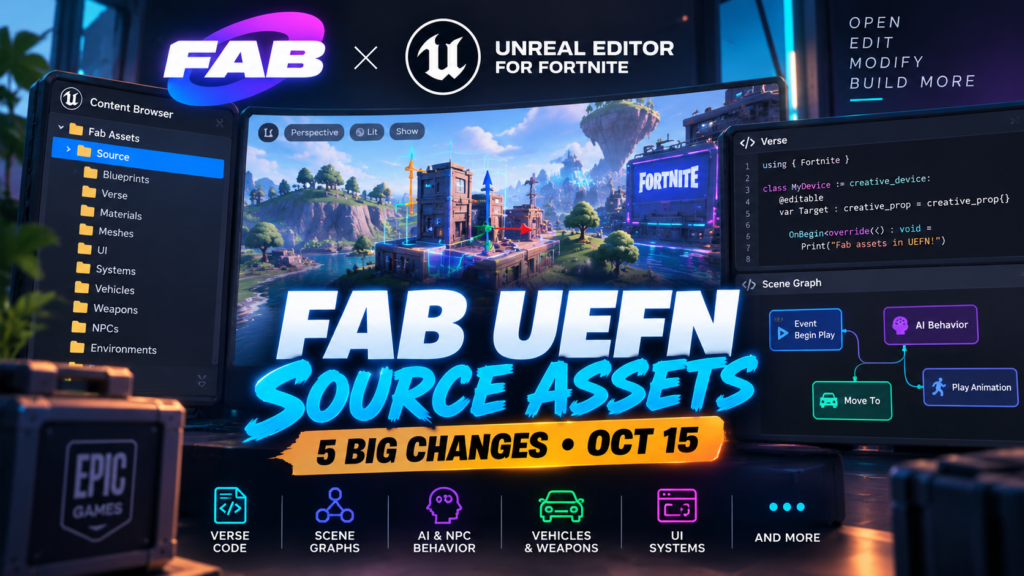
Fab UEFN Source Assets are coming on October 15, and this is a bigger change for Fortnite creators than another batch of props.
Epic is opening Fab to complete, editable Unreal Editor for Fortnite projects and systems. Instead of buying a referenced asset that behaves more like a locked building block, creators will be able to acquire source projects they can open, inspect, modify and build on directly in UEFN.
That means the marketplace can move beyond meshes and materials into actual production systems: Verse code, Scene Graph content, AI and NPC behavior, vehicles, weapons, UI and other gameplay logic. For small teams, that can turn a week of rebuilding a known system into an afternoon of adapting one.
For sellers, it also creates a new product category. Fab publishers can already begin uploading UEFN Source listings ahead of the October 15 rollout, while Fab continues to offer its standard 88% seller revenue share.
1. Fab UEFN Source Assets are editable, not just referenced
The most important difference is ownership of the working source inside your project.
Current Fab content in UEFN can arrive as referenced content. That system has real advantages: smaller project size, faster moderation and automatic access to the publisher’s latest version. But referenced assets also come with limits. Epic’s own documentation says creators cannot change things such as LODs, collision or destructibility on referenced content.
Source assets are the other side of that trade. Epic says the new format delivers complete UEFN projects that buyers can import and edit. That is what makes this interesting for gameplay systems rather than just art.
If someone sells a polished NPC behavior system, vehicle framework or weapon setup, you are not merely calling into a black box. You can study the underlying project and adapt it to the design of your island.
That matters because the best marketplace purchase is rarely the thing that works forever without modification. It is the thing that gets you 80% of the way there without forcing you to rebuild the boring 80% yourself.

2. Scene Graph creators get a much more useful marketplace
Epic’s current UEFN documentation draws an important line between referenced and source content: referenced Fab assets are not compatible with Scene Graph Beta, while source assets are.
That turns the October 15 launch into more than a seller-format update.
Scene Graph is designed around entities, components and reusable gameplay structures. If creators can buy editable systems built with Verse and Scene Graph, Fab starts looking less like a shelf of art packs and more like a library of reusable game architecture.
That could be especially useful for solo creators who are comfortable modifying systems but do not want to invent every inventory, NPC, interaction or vehicle framework from scratch.
There is still a catch: reusable does not mean universal. A source system can be technically solid and still clash with your project’s architecture, memory budget or gameplay assumptions. Buy it because you understand the problem it solves, not because the screenshots contain enough neon to activate your credit card.
3. Sellers can package complete gameplay systems
Epic says Fab UEFN Source Assets can include systems built with Verse and Scene Graph, including AI and NPC behaviors, vehicles, weapons and UI.
That is a meaningful commercial opportunity for experienced UEFN developers. A creator who already built a robust system for a shipped island may be able to turn that engineering work into a marketplace product, provided the project is clean, original and suitable for distribution.
Fab currently gives publishers 88% of product revenue. Publishers set base prices in US dollars and must offer Standard-license products under Personal and Professional tiers, although the two tiers can use the same price or different prices.
Epic has not announced a universal price for UEFN source products. That is good. A tiny UI utility and a complete NPC framework should not be forced into the same price box.
For context, Fab’s pricing system lets publishers choose from preset price points, and prices can extend into the hundreds or even above $1,000 for high-value products. Whether UEFN creators will actually pay premium-tool money is something the market will have to prove after launch.
4. The submission rules are stricter than “zip it and ship it”
If you are thinking about selling a system, Epic’s technical checklist is worth reading before you start cleaning the project at 3 AM and discover your folder named FINAL_FINAL_USE_THIS_ONE is now part of the product.
A UEFN Source listing contains a complete project as a ZIP archive. Epic requires the project to open and run in the current live UEFN release, compile Verse cleanly, pass UEFN validation without errors or consequential warnings, and stay within Fortnite’s technical limits.
Publishers also need to clean up redirectors, remove unused folders, use clear English alphanumeric names, keep file paths to 140 characters or less, and remove the Saved and Intermediate folders before packaging.
Python files are specifically prohibited from UEFN Source archives.
There is another important quality-control detail: Fab does not guarantee that your references resolve just because the ZIP uploads successfully. Epic tells publishers to import the archive into a clean UEFN project, verify that references resolve and test that the demo level works as advertised.
That is good news for buyers in principle, but it also means “verified by Fab” should not be interpreted as “Epic personally regression-tested every feature in this system.” The publisher still owns a large part of the responsibility.
5. October 15 could change what “asset shopping” means in UEFN
Today, marketplace shopping often starts with a visual need: I need a castle, a weapon, a tree pack, a material.
Fab UEFN Source Assets add another question: what system do I not want to build from zero?
That is the same reason Unity and Unreal developers spend money on mature controllers, dialogue frameworks, save systems and AI packages. The value is not the number of files. It is the number of development hours you do not have to spend rediscovering solved problems.
For Fortnite creators, Fab UEFN Source Assets could make the marketplace much more strategically useful. A small team might buy a vehicle system, NPC framework and UI foundation, then spend its limited time on the map’s actual hook, art direction and moment-to-moment fun.
We are already tracking Fab’s asset side closely, including the current three limited-time free Fab assets. The source-asset rollout is different because it expands what Fab can sell, not merely what happens to be discounted this week.
It also fits the bigger Unreal ecosystem shift we have been watching around Unreal Engine 6 and Epic’s longer-term creator tooling roadmap. Epic increasingly wants content, tools and production workflows to meet creators inside its ecosystem instead of living in disconnected marketplaces.
Should buyers jump in on October 15?
Browse aggressively. Buy selectively.
The format is promising, but the first wave will be a new market. There will not be years of reviews, update history and community troubleshooting behind every product on day one.
Before buying a source system, check what problem it actually solves, which UEFN release it supports, whether it uses Scene Graph, how much Verse code it contains, what third-party dependencies it needs, how the seller handles updates, and whether the demo proves the system rather than simply making it look pretty.
Also pay attention to the license. Fab’s Standard license has Personal and Professional pricing tiers based on the buyer’s revenue, while UEFN Reference Only is a separate form that does not give you source access. Pricing can vary by product and tier.
One small documentation wrinkle is worth knowing before launch. Epic’s September 24 announcement gives October 15 as the source-asset availability date, while the current upload documentation still carries a pre-launch notice saying buyers cannot download UEFN Source yet. That is not a contradiction so much as documentation living in the awkward three-week window before the feature turns on.
Should developers sell Fab UEFN Source Assets?
If you have a genuinely reusable system and you are willing to support customers, this is worth investigating now.
The interesting opportunity is not dumping an old island project onto Fab. The opportunity is productizing a solved problem: clean architecture, sensible defaults, useful documentation, a working demo, and enough flexibility that another creator can make it theirs.
A good source asset should make the buyer think, “I can build my game on top of this.” A bad one will make them think, “Cool, I bought somebody else’s technical debt.”
Publishers can begin preparing and uploading UEFN Source products now. Buyers get access when the new format launches on October 15, 2026.
Read Epic’s Fab UEFN Source Assets announcement and prepare for the October 15 launch.

