
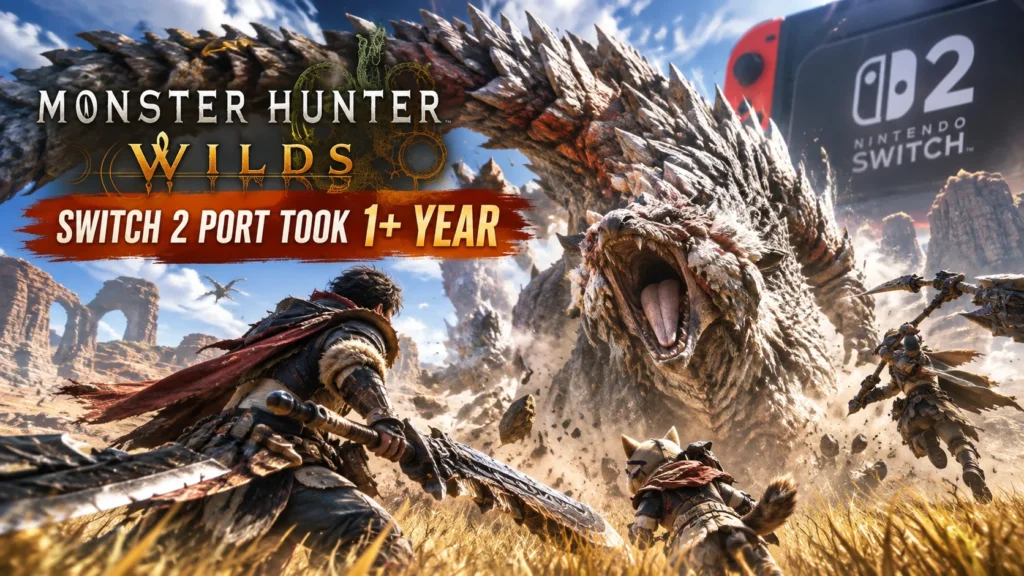
Monster Hunter Wilds coming to Nintendo Switch 2 was already big news. The more interesting part is how long Capcom says it has been wrestling the game onto Nintendo’s hardware.
A newly reported Famitsu developer interview says development on the Switch 2 version began around June 2025, with the team stressing that this was not a simple port. Capcom reportedly spent more than a year optimizing the game element by element for the platform.
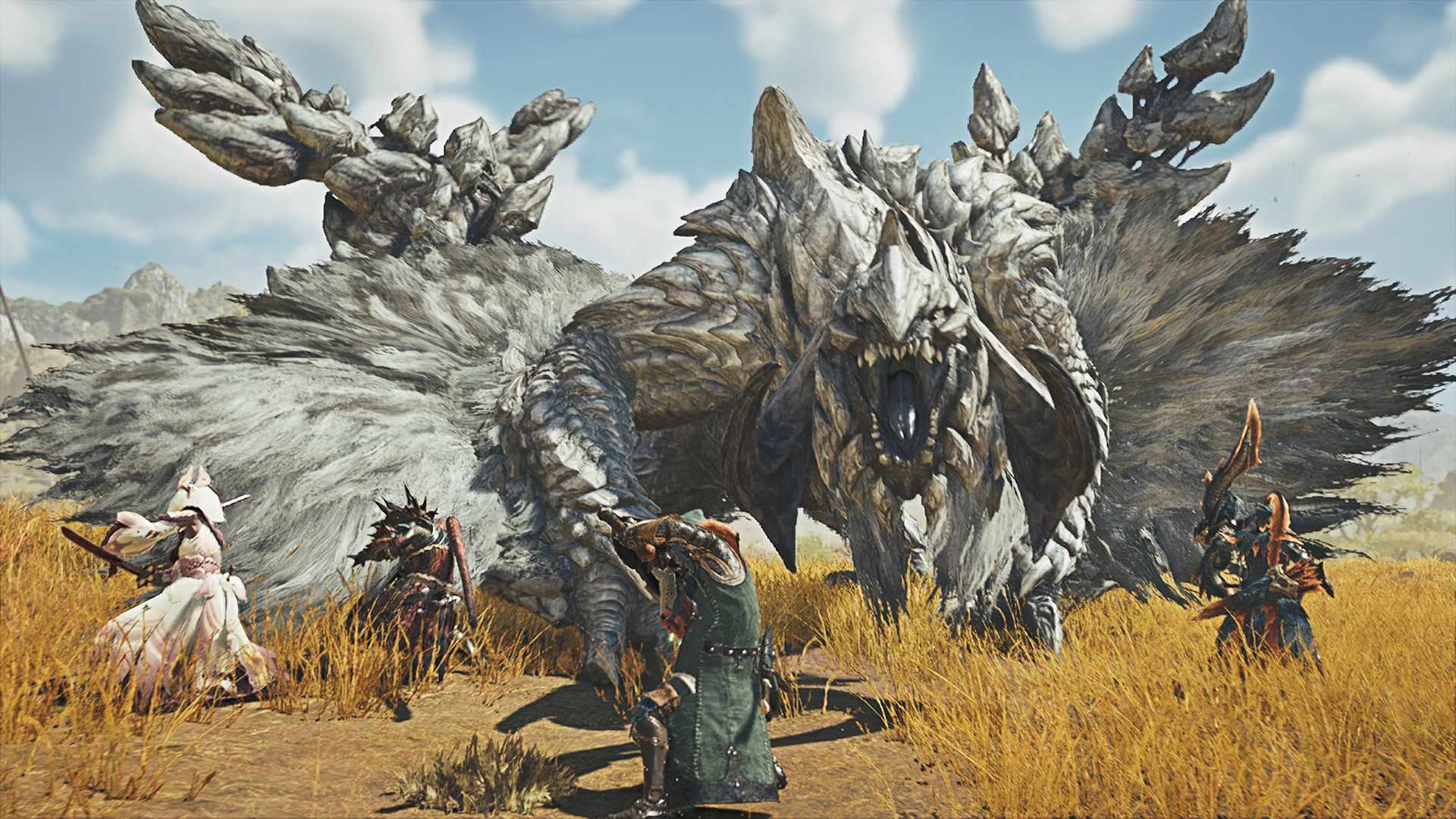
That matters because Monster Hunter Wilds is exactly the kind of game where a lazy port would be obvious. It has large moving monster populations, weather shifts, dense environments, online co-op and a simulation-heavy world that already pushes current hardware.
Switch 2 buyers therefore have a better question than whether the game can technically boot: has Capcom done enough platform-specific work to make Wilds feel like a real portable version rather than a compromised afterthought?
A Port That Started More Than a Year Before Launch
My Nintendo News, reporting on a new Famitsu interview with the development team, says work on the Switch 2 version started around June 2025. The developers described the process as optimizing individual parts of the game for Nintendo’s system rather than performing a straightforward conversion.
That puts the December 4, 2026 release in a different light. Capcom has had roughly a year and a half between the reported start of the Switch 2 effort and launch day.
Time alone does not guarantee a good port. But it does tell us this version was not assembled in the final few months after Nintendo hardware suddenly appeared on a roadmap.
Why Monster Hunter Wilds Is a Difficult Game to Shrink
Wilds is not simply rendering a hunter and a monster in an arena. The Forbidden Lands change as weather conditions shift, monster behaviour changes with those environments and creatures can move in packs across larger spaces.
That means optimization has to consider more than raw graphics settings. CPU load, world simulation, streaming, memory use, effects, animation, AI, network behaviour and asset density all compete for the same hardware budget.
A smart port can lower visual cost without destroying the game that sits underneath it. A bad one can hit its target resolution in an empty field and then collapse the moment the actual Monster Hunter chaos begins.
Capcom’s reported emphasis on optimizing each element is therefore exactly what Switch 2 owners should want to hear, even if we still need final retail testing before handing out victory medals.
What Nintendo Has Officially Confirmed
Nintendo’s official store page gives us several concrete details for the Switch 2 edition.
- Release date: December 4, 2026.
- Estimated file size: 39.1 GB.
- Play modes: TV, tabletop and handheld.
- Local wireless: up to four players.
- Online play: up to four players.
- HDR output: supported on compatible displays.
Nintendo’s Direct recap also says the Switch 2 release includes the free Title Update content available by launch and supports full cross-platform online multiplayer. That last point is huge for a late-arriving version because Switch 2 players are not being pushed into an isolated hunting population.
Monster Hunter Wilds: Ascendance is also planned for Switch 2 in 2027.
Local Wireless Might Be the Sleeper Feature
Cross-platform online play is the feature that keeps the community unified, but local wireless is the feature that makes this version feel specifically Nintendo.
Monster Hunter has a long history as a social portable game. Four Switch 2 owners being able to sit in the same room and hunt together without treating the console like a tiny stationary PC fits that history almost perfectly.
That does not make the Switch 2 version automatically superior. It gives it a reason to exist beyond portability.
What Capcom and Nintendo Still Have Not Fully Answered
There are still important buying questions we would not pretend are settled.
Nintendo’s product page does not publish a detailed frame-rate target, final docked and handheld rendering resolution, ray-tracing configuration or an exhaustive performance comparison against PS5, Xbox Series X|S and PC.
That means buyers who are sensitive to frame pacing should wait for final code analysis rather than turning preview footage into a performance guarantee.
We also want to know how the game behaves during the situations that matter most: large monsters in busy areas, heavy weather, multiplayer hunts and fast traversal through environments that need to stream assets constantly.
The fact that Capcom spent more than a year optimizing the port is reassuring. It is not a substitute for measurements.
Who Should Consider the Switch 2 Version?
Portable-first players: obvious audience. If the final version holds together well, being able to run full Wilds hunts away from a TV is the entire sales pitch.
Groups that actually meet in person: local wireless adds something the other versions do not emphasize in the same way.
Existing Wilds players: cross-platform multiplayer makes a second copy more useful because your Switch 2 friends can still join the broader community. Before double-dipping, however, verify any account, save-transfer or cross-save details that matter to you rather than assuming cross-play also means cross-save.
Performance-first players: wait for final comparisons. Portability is the Switch 2 advantage. If your only priority is maximum image quality or frame rate, there is no reason to preorder before independent testing.
The December Timing Is Clever
December 4 puts Wilds in the holiday window with months of patches and content already behind the original release. A late port can feel stale when it arrives empty. This one is being positioned more like a mature edition entering a new ecosystem with the accumulated free updates included.
That may be a better experience for Switch 2 owners than getting version 1.0 on day one and living through every early growing pain.
It also gives Capcom a runway into Ascendance in 2027. If the base game lands well on Switch 2, the expansion arrives to an audience that has had time to build characters and learn the hunt.
ZerotoBeast Take
The most encouraging Switch 2 detail is not a resolution number. It is the development timeline.
Capcom reportedly started this version around June 2025 and treated it as an optimization project rather than a quick conversion. For a demanding game like Wilds, that is exactly the kind of engineering investment the hardware needs.
Now comes the boring but necessary part: prove it in final code.
If performance is stable enough during real hunts, the combination of portability, local wireless, full cross-platform online play and a year’s worth of accumulated content could make Switch 2 one of the most convenient ways to live inside Monster Hunter Wilds.
If it struggles when the ecosystem gets busy, no amount of development history will make dropped frames disappear.
December 4 is when the engineering story becomes a player experience.
Official Nintendo Direct
Sources
- Nintendo Canada: Monster Hunter Wilds for Switch 2
- Nintendo Direct 9.9.2026 official page
- My Nintendo News: Famitsu developer interview report
We previously covered the broader September Nintendo Direct in our Nintendo Direct September 2026 roundup.

