
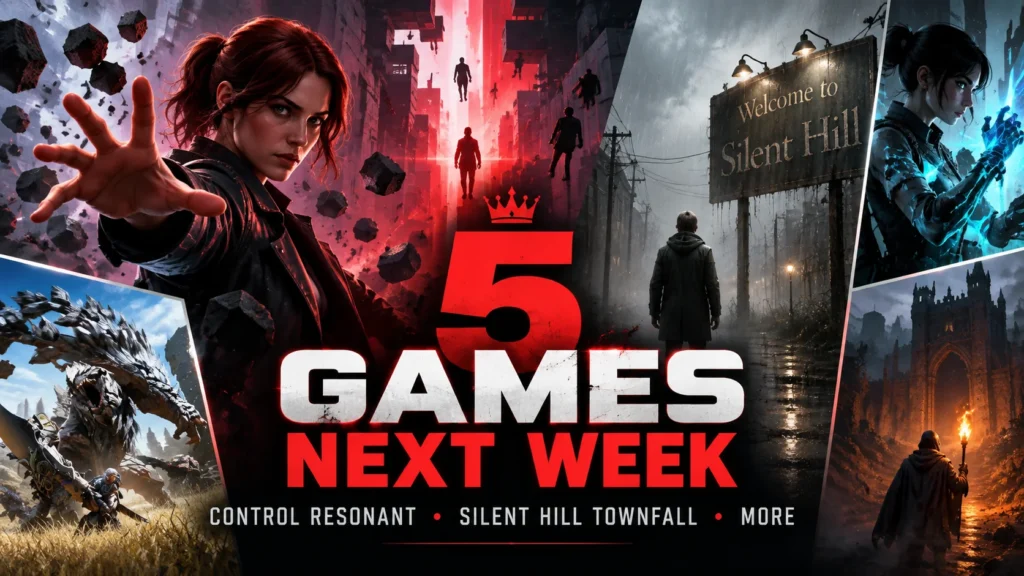
Next week is the kind of release week that can quietly mug your backlog in an alley.
Control Resonant and Silent Hill: Townfall are the obvious headline games, but the September 21 to 25 window is also carrying a tactical Dungeons & Dragons crossover, a six-years-in-the-making Korean dark-action RPG and a tiny matchstick-wielding bird trying to overthrow a wicked queen.
Rather than dump a calendar on you, we ranked the five releases we think deserve the closest look.
How We Ranked Them
Every game was scored using the same five criteria:
- Player value and appeal: 30% – how compelling the overall proposition looks for its likely audience.
- Gameplay distinctiveness: 25% – whether the game has a strong mechanical identity instead of simply belonging to a popular genre.
- Release confidence: 20% – how much substantial official information, footage or hands-on material exists before launch.
- Audience reach: 15% – how broad the potential audience is across platforms, subscriptions and genre interest.
- Surprise factor: 10% – how much the game has the potential to punch above its current visibility.
This is not a review ranking. We have not played these games. It is a pre-release watchlist based on what the developers, publishers and platform holders have actually shown.
#5: Well Dweller
Release: September 22 | Xbox Series X|S, Xbox on PC and Game Pass
Well Dweller has one of those pitches that does half the marketing work by itself: you are a tiny bird named Glimmer, armed with a matchstick, descending through a rotten fairy-tale kingdom to kill a wicked queen and save your family.
It comes from the creators of Crypt Custodian and Islets, which immediately gives the project more credibility than its tiny protagonist might suggest. Official Xbox material describes a dark fairy-tale metroidvania built around exploration, new abilities, secrets, puzzles and combat against increasingly strange creatures.
The biggest advantage here is accessibility. Game Pass removes most of the buying friction, so players who like compact metroidvanias can simply try it instead of spending three days conducting a personal investment committee meeting over a $20 indie.
Why it ranks fifth: the concept is charming and Game Pass gives it reach, but it is entering one of the most crowded indie genres in gaming. It needs execution, level design and boss quality to turn the premise into something people remember after the credits.
#4: Demeo x Dungeons & Dragons: Battlemarked
Release: September 22 | $29.99 on Xbox | Xbox Play Anywhere
Demeo already proved that tabletop-style tactical adventuring can work extremely well in a digital space. Battlemarked adds the license everybody immediately understands: Dungeons & Dragons.
The official pitch is a cooperative digital board game set in the Forgotten Realms, with turn-based combat, choice-driven storytelling and six familiar classes: paladin, sorcerer, ranger, fighter, bard and rogue.
That combination matters because D&D games tend to split into two extremes. Some demand a giant RPG commitment. Others simplify the rules so aggressively that the tabletop identity disappears. Battlemarked is aiming for a middle ground: recognizable classes, tactical positioning, cooperative decisions and sessions designed to be easier to pick up.
Who this is for: groups that love the idea of a D&D night but cannot consistently assemble four adults, snacks, character sheets and six uninterrupted hours in the same physical room.
Why it ranks fourth: the license and proven Demeo foundation make it easy to understand, but the ceiling depends on campaign depth and how much meaningful choice survives beyond the board-game structure.
#3: The Relic: First Guardian
Release: September 24 | Xbox Series X|S and Xbox Play Anywhere
This is the wildcard.
The Relic: First Guardian has been built for six years by a core team of roughly a dozen people at Project Cloud Games. That alone is not a reason to buy it, but it does explain why the project feels unusually ambitious for its team size.
Official Xbox material describes a dark action game inspired by classic Korean stories, built around a vast interconnected realm, forgotten ruins, hidden dungeons, environmental lore and combat that deliberately balances power with vulnerability.
That last phrase is the part we care about. Plenty of action RPGs can make you look powerful. Fewer understand that combat becomes exciting when power and danger coexist. If every attack is safe, combat becomes animation playback. If every mistake feels arbitrary, it becomes homework. The Relic is explicitly pitching itself around that tension.
The exploration structure also sounds promising. The world of Arsilthus is supposed to reward players for leaving the obvious route with artifacts, secret encounters and buried story fragments. That is exactly the kind of design that can make an interconnected action RPG feel authored instead of merely large.
Why it ranks third: enormous upside, distinctive cultural inspiration and a long development runway. The uncertainty is scale. A twelve-person core team attempting a large interconnected action game has very little room for production weakness.
#2: Silent Hill: Townfall
Release: September 24
Townfall is not trying to be Silent Hill 2 again, and that is probably the smartest thing about it.
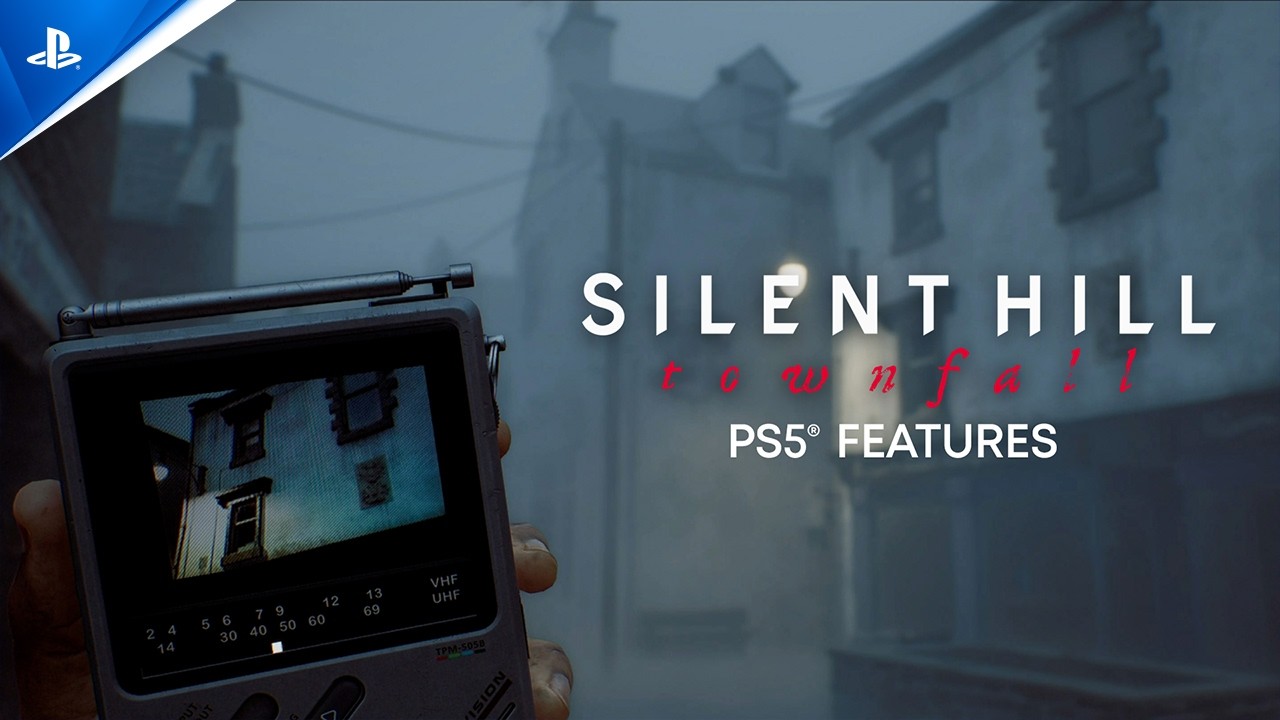
Konami and Screen Burn Interactive describe it as the first full-length Silent Hill game presented in first person. You play Simon, who washes ashore on the isolated island of St. Amelia with one vague instruction: put things right.
The signature tool is the CRTV, a handheld device that replaces the classic radio. It can be used to scout roaming monsters, uncover puzzle clues and investigate the island. That gives the game a physical object around which exploration, danger and information can all orbit.
The PlayStation feature breakdown also reveals how much of the horror is being built around sensory uncertainty. The team says 3D audio is critical because the first-person perspective narrows what players can see. Ray-traced lighting reacts to flashlights, alarms, fog and transitions into the Otherworld. DualSense haptics and adaptive triggers are being used to communicate weapon weight and nearby threats, while motion controls can fine-tune the CRTV or aiming.
Most importantly, the developers say the horror is less focused on constant gore and jump scares than on tension that builds and releases at the right moment. The story also appears interested in the relationship between individuals, corporations and wider society, which sounds much closer to Silent Hill’s psychological roots than a simple monster-house setup.
Why it ranks second: it has a clear identity, strong platform-specific design and a horror concept that feels connected to Silent Hill without copying an earlier game. It misses first because horror remains a narrower audience and Control Resonant currently has more substantial hands-on evidence behind it.
#1: Control Resonant
Release: September 24 | $59.99 on Xbox | Xbox Play Anywhere | Also launching on PS5
Control Resonant takes the strangest parts of the first Control and gives them a city to break.
Remedy’s sequel shifts the lead role to Dylan Faden and leaves the Oldest House for a warped Manhattan under paranatural attack. That alone changes the scale of the series. Dylan can double-jump, air-dash, traverse rooftops and eventually use abilities such as a grappling hook, which makes the environment part of the power fantasy instead of merely a backdrop.
Combat is also more melee-forward than Jesse’s telekinetic gunfights. Dylan’s shapeshifting Aberrant weapon has multiple forms, status effects and upgrade paths. Additional combat abilities can create shields, projectile barrages or even temporary allies assembled from environmental junk. Power is recovered through melee attacks, encouraging aggression instead of endless retreat.
What gives Control Resonant the highest release confidence is the amount of detailed hands-on information already available. PlayStation Blog’s full-game preview describes focused Manhattan sandboxes rather than a traditional open world, optional memory-based side activities, skill trees, arcade challenges, creepy reality shifts and bosses called Resonants that can completely change the rules of an encounter.
That structure sounds like Remedy avoiding the classic sequel trap. The game is larger, but it is not simply promising more square kilometers. It is using the added space to support traversal, combat and stranger encounter design.
Why it ranks first: the sequel has the broadest combination of production confidence, mechanical expansion and proven developer identity in this week’s group. We know what Control was good at, and the material shown for Resonant suggests Remedy understands which parts deserve to grow.
Honorable Mentions
Gunstoppable deserves attention if movement shooters are your thing. Its entire combat pitch is built around speed: grapple, slide, wall-run, rail-grind, parry bullet-hell attacks and keep momentum high enough to increase your damage.
Nomori is for puzzle players who enjoy having their brain politely folded into a different dimension. You rotate portals, redirect gravity, manipulate time and turn walls into floors.
Sandwalkers also stood out for its caravan structure, where expeditions push through dangerous meteorological chaos to reconnect isolated communities and send accumulated memories home.
What Should You Actually Play?
If you want the safest premium bet, Control Resonant has the strongest body of evidence behind it.
If you want horror, Townfall is the more interesting risk because it is clearly trying to build a different kind of Silent Hill rather than cosplay an old one.
If you want something that could surprise people, keep The Relic on your radar. Small teams do not get six years of development back. The ambition is real, and September 24 is when we find out whether the execution matches it.
If you want low-friction experimentation, Well Dweller on Game Pass is almost impossible not to sample.
And if your group has been looking for a tactical game-night replacement, Battlemarked may be the easiest sell of the week.

