
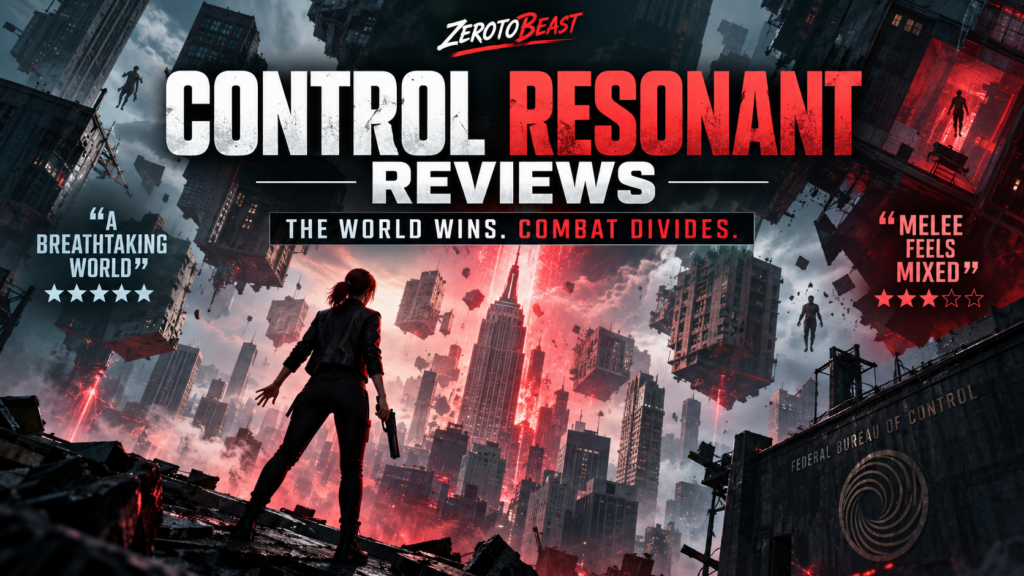
Control Resonant looks like exactly the kind of sequel Remedy fans hoped for in one way: it is stranger, bigger and more eager to turn reality into a piece of hostile architecture.
The part critics cannot agree on is what happens when Dylan Faden has to hit something.
Reviews for Control Resonant landed ahead of its September 24 launch on PlayStation 5, Xbox Series X|S and PC. Across the coverage we reviewed, the same broad pattern keeps appearing: the warped version of Manhattan, exploration, atmosphere and Remedy’s supernatural world-building are drawing strong praise. The new melee-focused combat is much more divisive.
That makes the buying decision unusually clear depending on what you loved about the original Control.
Quick Take
Buy or strongly consider it if the Oldest House, environmental weirdness, exploration and Remedy’s interconnected universe were the biggest reasons you loved the first game.
Watch more combat footage first if Jesse’s telekinetic gunplay was your favorite part. Resonant deliberately pushes Dylan toward close-range melee, and several critics found that side of the game less satisfying than the world around it.
Platform: PS5, Xbox Series X|S and PC on September 24. Remedy says a Mac version follows later in 2026.
Important context: ZerotoBeast has not played the game. This is a researched buyer guide built from Remedy’s official material and the first wave of independent reviews.
Remedy Did Not Make “Control Again, but Bigger”
Resonant shifts the lead role to Dylan Faden, Jesse’s brother, and moves the action beyond the Oldest House into a version of Manhattan that has been twisted by an otherworldly resonance. Jesse is missing, reality is unstable and the city itself becomes the mystery.
Remedy describes the game as an open-ended action-adventure RPG rather than a straight repeat of the original structure. Manhattan is split into large, distinct zones with side activities, hidden encounters and spaces altered by gravity and resonance.
From the footage and review coverage, that broader structure is one of the sequel’s biggest wins. Critics repeatedly point to the city’s impossible architecture, changing spaces and visual identity as the reason they kept exploring.
The World Seems to Be the Easy Part to Recommend
GamesRadar’s review praised the supernatural vistas and world-building while criticizing parts of the combat and traversal. TechRadar highlighted the art direction, open exploration and movement, while noting that combat takes time to open up and that enemies can feel overly durable. PC Gamer similarly praised the world, narrative and traversal while raising concerns about melee balance and repetitive encounters.
Those reviews do not agree on every detail, but the overlap is useful. Resonant appears strongest when it is asking you to look around, poke at an impossible space and wonder what Remedy is about to do next.
That is important because Control was never only about combat. The Federal Bureau of Control, altered items, threshold spaces and the game’s deadpan bureaucracy gave the original a personality that few action games could imitate.
If that personality was the hook, Resonant appears to understand the assignment.
Dylan’s Weapon Changes the Feel of Combat
The biggest mechanical change is An Aberrant, Dylan’s shapeshifting melee weapon. Remedy has shown it taking multiple forms and combining with supernatural abilities rather than simply replacing the Service Weapon with another gun.
That shift creates a different rhythm. Resonant wants Dylan closer to enemies, moving aggressively and chaining attacks with powers. On paper, that gives him a distinct identity instead of making him Jesse with a different haircut.
The review split suggests that distinction comes with a cost.
Some critics enjoyed the more physical, aggressive style once the systems opened up. Others found the melee less precise or less satisfying than the original game’s mix of telekinesis and firearms. Repetition and enemy durability also came up as complaints in multiple reviews.
That does not automatically mean the combat is bad. It means the combat is the part of this sequel where personal taste matters most.
If You Loved Launch, Levitate and the Service Weapon, Pay Attention
The original Control created one of those rare action-game loops where throwing a forklift across a room could feel as natural as firing a pistol.
Players who loved that specific balance should not assume Resonant is trying to preserve it exactly. Remedy’s sequel is intentionally changing the lead character, environment and primary weapon language.
Before buying, watch uninterrupted combat footage rather than only trailers. Look at how frequently Dylan is forced into close range, how enemies respond to hits, how much ability use breaks up melee strings and whether the overall cadence appeals to you.
If the answer is yes, the world around that combat looks like a very strong reason to jump in. If the answer is no, waiting for a sale will not make you less of a Remedy fan. It will make you a Remedy fan with money left for coffee.
The Exploration Upgrade May Matter More Than the Combat Debate
One of Resonant’s most interesting changes is scale. Remedy is not positioning Manhattan as a conventional checklist open world, but it is giving players larger areas with alternate routes, activities and secrets.
That could solve one of the original game’s quieter limitations: the Oldest House was fascinating, but navigation often felt like wrestling with the map rather than discovering space naturally.
Reviewers who praised Resonant’s traversal and exploration suggest the sequel has found a better rhythm between moving through the world and uncovering its weirdness.
For players who like environmental storytelling, optional encounters and wandering into places they were not explicitly sent, that may be the sequel’s biggest upgrade.
PS5 and PS5 Pro Buyers Already Know the Performance Target
We previously covered Remedy’s technical targets in detail. The studio built the PS5 version around a 60 FPS performance mode, while PS5 Pro also gets a 40 FPS ray-tracing option for players using a compatible 120 Hz display.
That does not guarantee every moment will be flawless, but it gives console buyers more concrete information than the usual pre-launch “optimized for next-gen” sentence.
You can read our full Control Resonant PS5 and PS5 Pro breakdown here.
Who This Looks Built For
Remedy universe fans: you are the easiest audience to recommend this to. The world, mystery and surreal presentation are exactly where early reviews sound most enthusiastic.
Exploration-first action players: the larger zones and environmental weirdness look like a substantial part of the experience rather than connective tissue between fights.
Original Control combat purists: watch first. Dylan’s melee focus is a deliberate departure, not a cosmetic reskin.
People who hate spongy enemies or repetitive encounters: several reviews specifically raise those concerns. Waiting for more player feedback after launch is reasonable.
What We Still Want to Know After Launch
Critic reviews are useful, but the first week of player feedback will answer questions reviews cannot fully settle.
How does progression feel after twenty hours? Does enemy scaling stay satisfying? How stable is the PC version across a wider range of hardware? Do the larger zones remain interesting once the novelty wears off? And does the melee system deepen enough to reward players who stick with it?
Those are the questions that matter if you are not buying on day one.
ZerotoBeast Take
From the review pattern, Control Resonant appears to have nailed the part that would have been hardest to fake: it still feels like Remedy built the world.
Warped Manhattan sounds strange, beautiful and worth getting lost in. Dylan’s combat is the variable.
If the first Control lived in your head because of the Oldest House, the documents, the impossible rooms and the feeling that reality had a paperwork department, Resonant looks very promising.
If you mainly remember launching concrete into enemies and emptying the Service Weapon into whatever survived, watch some longer combat footage before handing over your money.
That is not a weakness in the recommendation. It is the useful part of it.
See Control Resonant on Remedy’s official site

