
Roblox just made one of the more interesting game-development moves of 2026, and it is bigger than “AI can make a Roblox game now.” At RDC 2026, the company outlined a future where creators can generate functional scenes from prompts, build on phones, use AI agents for testing and analytics, support offline play, and eventually ship Roblox-powered games as standalone apps across mobile, PC and consoles.
That last part is the eyebrow-raiser.
Roblox has spent years being a platform you publish into. Now it increasingly sounds like an engine and backend stack you may be able to publish through.
What Roblox actually announced
At RDC 2026, Roblox said creators will eventually be able to make experiences available as standalone apps while Roblox continues powering the underlying technology and services. It also plans browser play through Chrome by the end of 2026, with more browsers to follow, and offline solo play by mid-2027.
On the creation side, Roblox is expanding Build, its mobile-first prompt-driven creation system. The company says roughly 9,000 games have already been published through Build during its early rollout, and 71% of people who created with it had never used Roblox Studio before.
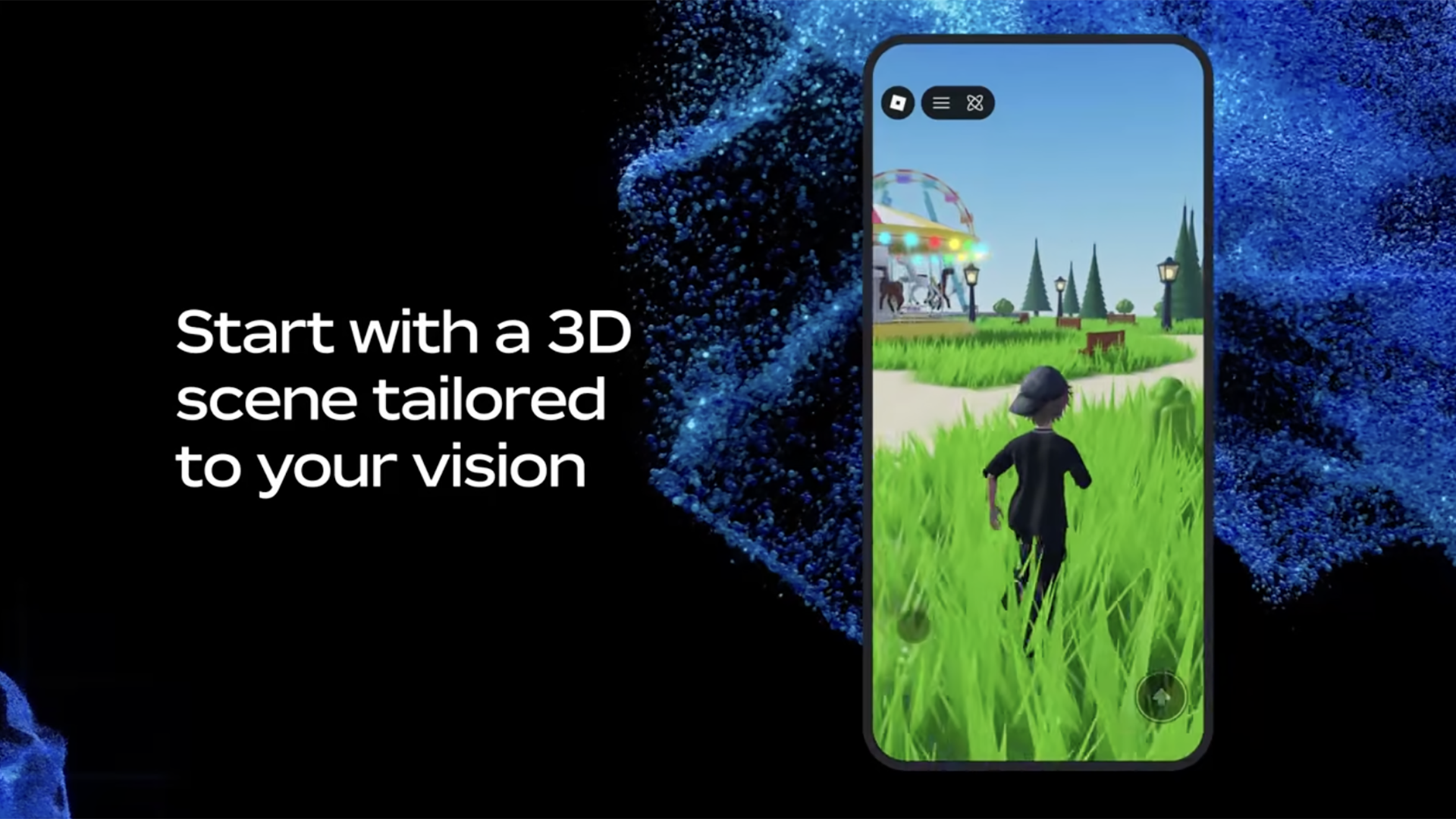
Then comes Scene Generator. Roblox says that later this year creators will be able to provide a text prompt and reference image and receive a functional scene layout that can be refined in Studio.
This is not just “AI slop but faster”
The obvious concern is that lowering the barrier to game creation also lowers the barrier to flooding a storefront with junk. Roblox knows that criticism exists. In its July announcement, the company explicitly said its retention-based discovery system is not designed to reward games nobody wants to play. In less corporate language: generating a game is not the same thing as generating an audience.
That distinction matters. Prompt-to-game tools can make prototypes cheaper. They cannot magically make pacing good, onboarding clear, combat satisfying, economies fair, stories memorable, or players care.
The useful part for serious developers is not “type one sentence, receive Fortnite.” It is the possibility of delegating repetitive production work while keeping human control over the parts that actually create taste.
The professional tools are arguably more important than Build
Roblox has also described upcoming agents for playtesting, analytics and experimentation. A playtesting agent that surfaces bugs before players encounter them is immediately understandable. An analytics agent that lets a developer ask questions in plain English could reduce the amount of dashboard archaeology required to answer basic retention questions. An experiment agent that suggests tests aimed at engagement or monetization could be valuable if developers treat it as an assistant rather than an oracle.
That is where this starts sounding familiar to anyone watching Unity, Unreal, coding agents, procedural generation tools and AI-assisted art pipelines. The industry is moving toward a model where developers direct increasingly capable systems instead of hand-authoring every intermediate step.
We have already been following that shift on ZerotoBeast in our coverage of Unity 7 and Unreal Engine’s PCG-heavy City Sample. Roblox is attacking the same productivity problem from the opposite direction: start with accessibility, then stretch upward toward professional workflows.
Standalone apps change the business question
Historically, choosing Roblox meant accepting the Roblox ecosystem as both your superpower and your cage. You got hosting, identity, multiplayer infrastructure, discovery, monetization and a giant audience—but your game lived inside Roblox.
If Roblox Everywhere works the way the company describes, that tradeoff becomes more interesting. A creator could potentially use Roblox’s engine and services while reaching players through a standalone app instead of forcing every user through the Roblox client.
There are still huge unanswered questions: branding requirements, revenue share, app-store rules, data ownership, platform certification, API limits, how much visual or technical identity can diverge from Roblox, and whether “standalone” really feels independent in practice.
Until those details exist, nobody should cancel their Unity or Unreal project because of one conference slide. But the direction is important.
Should indie developers care?
Solo developers and very small teams should absolutely watch this. Roblox is bundling engine technology, global publishing infrastructure, AI creation, analytics, monetization and potentially standalone distribution into one stack. If that reduces operational overhead without trapping developers inside an unacceptable business model, it becomes a legitimate production option rather than merely a kids-platform curiosity.
Established premium PC/console teams should watch, not migrate. Unity, Unreal, Godot and proprietary technology still provide far more control over rendering, native systems, packaging, middleware and distribution. Roblox has not suddenly erased those advantages.
Non-programmers have the most immediate opportunity. Build is explicitly targeting people who have an idea but not the traditional technical path to prototype it. Nine thousand published Build games is already enough evidence that lowering friction creates new creators—even if only a tiny percentage ever become commercially meaningful.
The Catch
The hard part of game development was never merely putting an object in a scene. It is deciding what belongs there, why the player should care, what happens 30 minutes later, why they return tomorrow, and whether the whole thing still works on a terrible Wi-Fi connection and a phone somebody bought four years ago.
AI can compress execution time. That makes direction more important, not less.
ZerotoBeast Take
RDC 2026 is worth paying attention to because Roblox is quietly expanding its ambition from “platform with creator tools” toward something closer to a cloud game-development operating system. Roblox itself used similar language when describing the engine, infrastructure and services underneath its creator ecosystem.
If standalone apps, offline play and prompt-to-scene generation mature together, Roblox may end up competing for developers who previously would never have considered it. The hilarious part is that the most disruptive engine story of the year might arrive wearing blocky avatars.
Read Roblox’s RDC 2026 announcement →

