
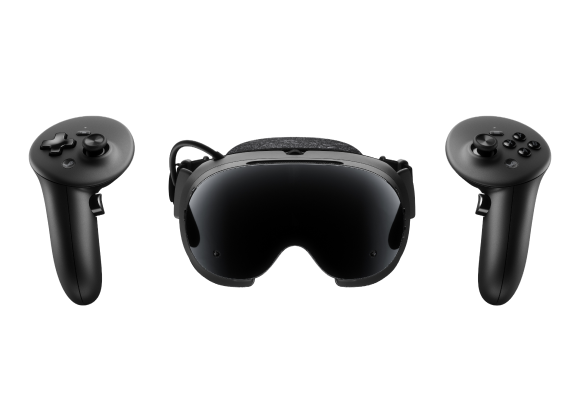
Valve has finally put a price on the idea of strapping Steam to your face, and in Canada that idea starts at $1,529 CAD.
The Steam Frame is now launching as Valve’s all-in-one VR headset: it can stream your Steam library wirelessly from a gaming PC, run supported games directly on the headset, and even turn regular flat-screen PC games into a giant virtual display. The cheaper 256GB model is $1,059 USD / $1,529 CAD, while the 1TB model climbs to $1,299 USD / $1,859 CAD.
That is not impulse-buy territory. This is less “Quest alternative for everybody” and more “premium Steam hardware for the person who already knows exactly why they want it.” And that distinction matters, because the Frame’s strongest argument is not a single specification. It is the way Valve is trying to connect PC gaming, standalone VR and SteamOS into one device.
Quick Take
Most interesting for: PC gamers with strong Steam libraries, VR enthusiasts who hate cables and base stations, and early adopters who want Valve’s most ambitious headset ecosystem.
Think twice if: you mainly want inexpensive standalone VR, you are sensitive to first-generation hardware pricing, or you would be annoyed by buying a $1,500-plus headset before the software library proves itself.
ZerotoBeast take: The hardware proposition is genuinely interesting. The price is the fight.
What Steam Frame Actually Is
Steam Frame runs SteamOS and uses a Snapdragon 8 Gen 3 platform with 16GB of memory. It does not need external base stations, and Valve built it around two ways of playing: render locally on the headset when a game has a suitable build, or stream wirelessly from a PC when you want the full desktop version.
The second mode may be the more important one for existing PC players. Valve includes a dedicated 6GHz wireless adapter, and the headset uses eye tracking for foveated streaming — concentrating higher image quality where you are actually looking instead of wasting bandwidth equally across the whole display.
That gives Steam Frame a simple fantasy: your PC can stay across the room while your head stops being tied to it by a cable.
The headset itself uses 2160×2160 LCD panels per eye with pancake lenses and refresh rates ranging from 72Hz upward. It also includes tracked controllers, onboard speakers, microSD expansion and support for non-VR Steam games on a virtual screen.
The Killer Pack-In Is Half-Life: Alyx

Every Steam Frame includes Half-Life: Alyx. That alone is not enough to justify a four-figure headset, obviously, but the important part is how Valve got it there.
Valve has ported Alyx to run natively on the Frame’s ARM hardware rather than requiring a gaming PC to render it. The port retains the game’s assets, supports existing saves and mods, and uses the headset’s eye tracking and rendering stack to make a game originally designed around PC VR work on a standalone processor.
That is bigger than a free copy of an old game. It is Valve demonstrating the kind of software bridge Steam Frame needs if this hardware category is going to matter. A standalone headset is much more compelling when its best case is not restricted to mobile-style VR software.
The Canadian Price Changes the Conversation
At $1,529 CAD for 256GB, Steam Frame is immediately asking a different question than a mainstream headset: how much is the Steam ecosystem worth to you?
The 1TB jump to $1,859 CAD makes the storage decision easier than it looks. The Frame supports microSD expansion, so the 256GB model is likely the rational starting point for many buyers unless they know they will keep large native games installed locally.
There are extra costs too. Valve is selling comfort and replacement accessory kits separately, and even the USB-C charger is not bundled in every configuration. That is worth checking before checkout; a premium device becomes a little less charming when the cart starts growing tentacles.
The Launch Uses a Lottery
Valve is not simply opening the floodgates. Buyers can register through September 17, after which the initial order is randomized. Selected customers get a limited purchase window, while everyone else can roll into a waitlist as more units become available.
That means there is no reason to panic-buy from a reseller. If you are interested, use Valve’s official reservation system and keep the scalper tax where it belongs: in the bin.
Who This Is For
The strongest customer is somebody who already lives inside Steam. You have a capable gaming PC, you own VR titles or want to explore them, and the idea of one headset that can move between high-fidelity PC streaming and standalone play sounds more useful than maintaining separate ecosystems.
It also makes sense for the technically curious crowd that liked the Steam Deck because Valve tends to treat its hardware as a platform rather than an appliance. SteamOS, Proton and Valve’s willingness to do strange engineering work like an ARM64 Alyx port are exactly the reasons this is interesting.
But if your priority is simply “I want good VR for the least money,” the Frame’s price is hard to ignore. The mature Quest ecosystem remains a serious counterargument, and launch-day hardware always carries uncertainty around long-term software support, comfort, battery behavior and how quickly developers embrace native Frame builds.
The Catch
The biggest unknown is not whether Steam Frame can do cool things. It clearly can. It is whether enough of those things become normal rather than impressive launch demos.
Native standalone support will need more than Alyx. Developers need reasons and tooling to target the device. Wireless streaming needs to remain dependable across real home-network conditions. And buyers spending this much should expect Valve to support the platform aggressively for years, not merely win a spectacular engineering award and wander off to build another controller.
We also would not treat early battery-life anecdotes or launch-day performance reports as universal truth yet. Independent testing across more games and network setups will matter more than one review environment.
ZerotoBeast Take
Steam Frame is the kind of product that makes PC gaming more interesting even if most people should not rush to buy one.
Valve is trying to erase the annoying borders between “PC VR,” “standalone VR” and “my normal Steam library.” That is a genuinely compelling direction. But at $1,529 CAD, the first wave is for enthusiasts, not curious newcomers.
If you already have the PC, already want premium VR and already trust Valve’s SteamOS ecosystem, get into the official reservation queue and decide when your purchase invitation arrives. If you are VR-curious rather than VR-committed, wait for deeper reviews, more native games and the inevitable answer to the only question that matters after launch: does this thing become a platform?
Sources / Official Links
Valve — Steam Frame
Steam Hardware — Steam Frame launch announcement
Qualcomm — Steam Frame hardware listing
The Verge — launch pricing and reservation details
The Verge — native Half-Life: Alyx port details

