
AI can already generate a convincing clip of a world. The much harder problem is making that world remember where the door is after you turn around.
That is why Meshy’s newly detailed Mora research project is more interesting than the usual ‘look, an AI made a game’ headline. Mora, short for Multimodal Open-world Real-time Architecture, is built around a deliberately unglamorous idea: construct the world first, then render it.
Instead of asking one model to hallucinate the rules, geometry, visuals and audio at the same time, Meshy splits the job. Coding agents handle game logic and mechanics. Meshy’s 3D generation handles spatial structure and assets. A real-time video model handles the final presentation layer. Mora 1 is already publicly playable at mora.fun, with demonstrations spanning spatial puzzles, multiplayer platforming, building, racing and sports.
For game developers, that division of labor is the real story.
Why ‘construct first, render second’ matters
A game is not a video. It is a state machine wearing art.
The player expects a locked door to stay locked until the key is found. A platform needs to remain where the jump system thinks it is. A multiplayer opponent needs to occupy the same logical space for everyone. Rules have to survive camera changes, repeated interactions and the player doing something the demo author did not expect.
Purely video-driven world models can look astonishing while still struggling with persistent geometry and complex interaction. Meshy is explicitly designing Mora around that problem. The company says the architecture gives game rules and spatial relationships an explicit foundation in code and 3D graphics, leaving the video layer to concentrate on presentation.
That sounds less magical than ‘type a sentence and generate a universe.’ It is also much closer to how a usable production pipeline would need to behave.
Mora is still research, not a one-click game engine
This is the part worth keeping painfully clear. Mora 1 is an early research demonstration. Meshy describes a general-purpose world creation tool as a longer-term goal, and Mora 2 is still in development.
So this is not a reason to throw away Unity or Unreal. It is not evidence that a solo developer can generate a shippable open world this afternoon. And the public examples are demonstrations chosen to validate the architecture, not proof that Mora can already handle the full mess of saving, networking, AI navigation, animation state, combat balance, platform certification and optimization that turns a prototype into a commercial game.
But research architecture matters because it tells us what the company thinks the eventual workflow should look like. Here, the answer is not ‘one giant model does everything.’ It is an orchestrated stack of specialists.
That should sound familiar to developers using agents today
If you are already using coding agents with Unity, Unreal, MCP servers, 3D generation and automated testing, Mora’s philosophy is recognizable. The agent does not need to personally be the best modeller, programmer, renderer and tester. It needs to coordinate tools that are good at those jobs.
That is a healthier direction for practical game development because every layer can improve independently. Better coding agents can produce stronger mechanics. Better 3D generation can improve persistent assets. Faster video models can make the presentation layer richer without forcing the underlying game logic to be reinvented.
More importantly, developers can theoretically inspect and replace individual layers. A bad generated mesh is a mesh problem. A broken interaction is a logic problem. That is much easier to reason about than a monolithic model where ‘the world felt different on the next frame.’
Meshy 7.1 is the production-side half of this story
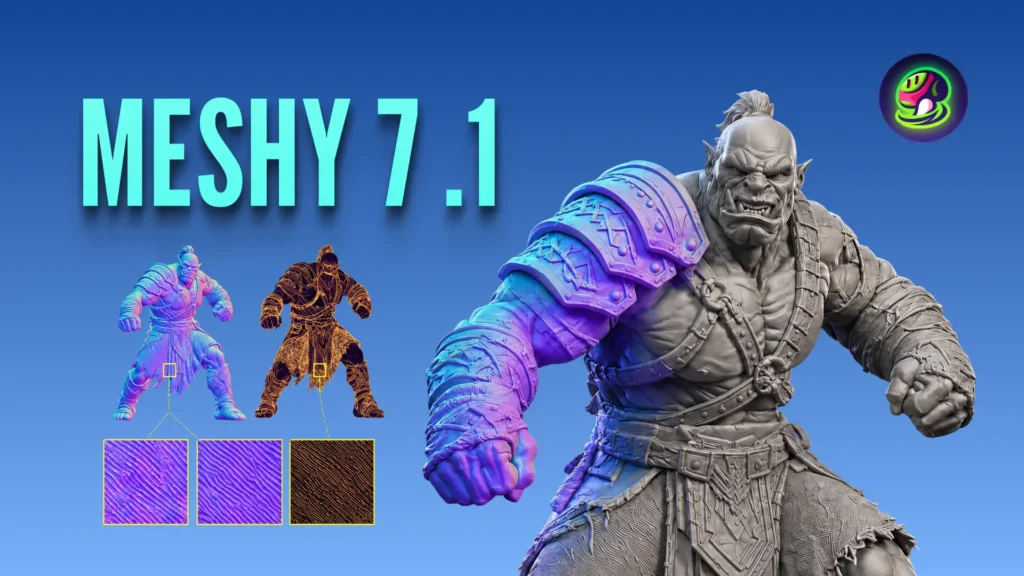
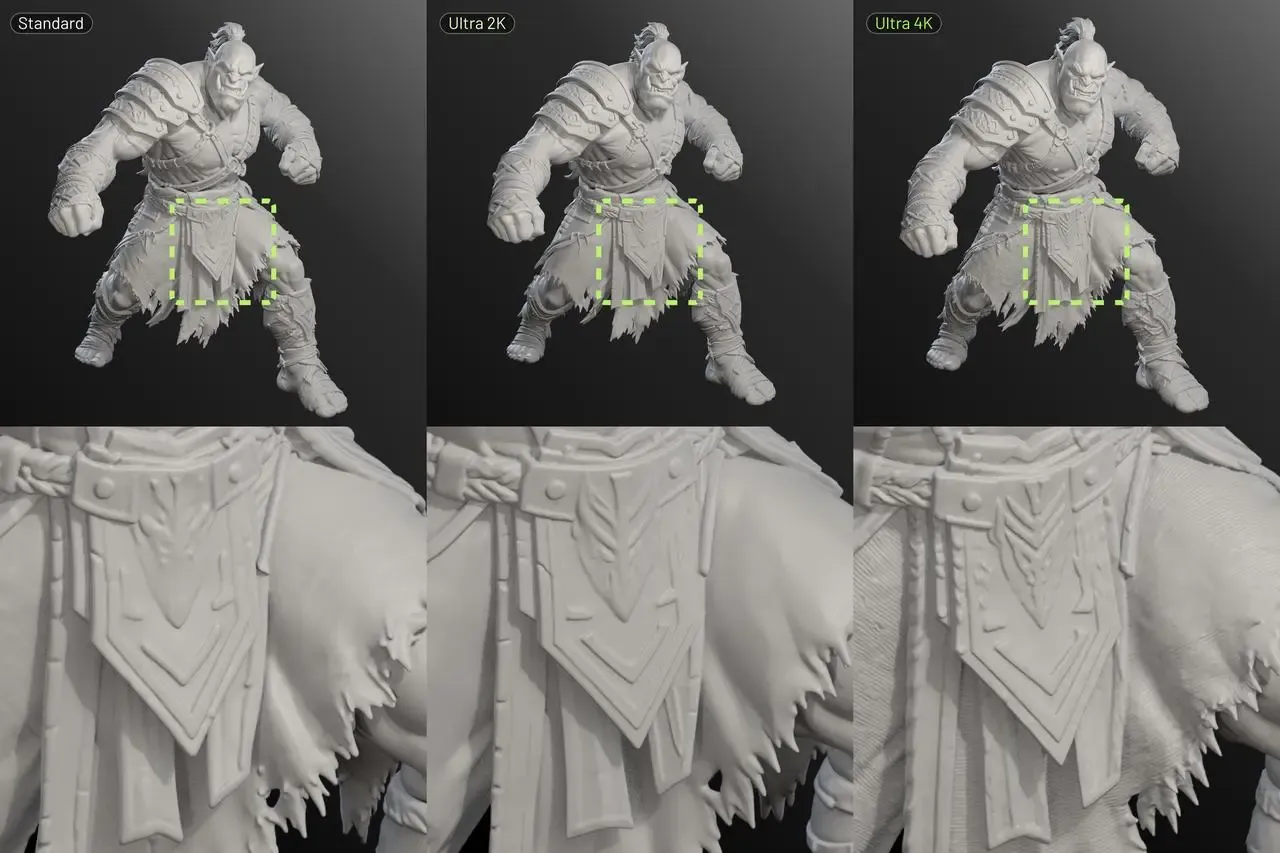
Meshy paired the Mora discussion with Meshy 7.1, its latest image-to-3D model. The headline feature is an Ultra 4K mode that generates geometry at a 4096³ voxel resolution, with raw meshes reaching up to 80 million triangles before simplification.
The practical distinction is that fine details such as stitching, woven fabric and scales can be represented as actual geometry rather than only painted into a texture. That can matter for sculpting, 3D printing, close-up assets and any workflow where silhouettes and real surface structure need to survive downstream.
There is a large asterisk here: Meshy’s benchmark results are Meshy’s own internal evaluation. The company says 7.1 ranked first against Tripo 3.1, Hunyuan3D 3.1, Rodin 2.5 and Hi3D 3.0 on its Detail Richness benchmark, but developers should treat a vendor-authored benchmark as evidence to test, not a universal verdict.
Ultra 2K and Ultra 4K also require a paid subscription, as do downloads from Meshy 7.1. Ultra 2K supports single-view and multi-view generation, while Ultra 4K is currently single-view only.
Who should actually care?
Solo and small-team developers: Mora is worth watching because it points toward an agent workflow where prototyping mechanics, 3D structure and presentation can happen in one coordinated loop. The time saving could be enormous if the output remains editable.
Technical artists: Meshy 7.1 is immediately more concrete. High-detail generated geometry can be useful as a source asset, but an 80-million-triangle raw mesh is obviously not something you casually drop into a mobile build and call optimization complete. Retopology, decimation, UVs, materials, LODs and art direction still matter.
Game designers: the most exciting version of this technology is not ‘AI replaces the designer.’ It is ‘the designer can test more ideas before lunch.’ If a rule change can propagate into a playable world quickly, iteration becomes cheaper.
Studios shipping production games today: treat Mora as R&D, not procurement. The architecture is promising; the product maturity required for production is not demonstrated yet.
The ZerotoBeast take
The industry keeps showing us AI-generated worlds as if the final frame is the hard part. For games, it is not. The hard part is making the world obey rules after the player arrives and starts breaking things.
Meshy’s decision to anchor Mora in code and 3D structure is therefore the part we would steal. Give agents specialist tools. Keep persistent state explicit. Let the renderer make it beautiful after the game knows what is actually there.
If Mora eventually becomes a creator-facing product that preserves editability and exports useful game data, it could become genuinely important. Until then, it is a research demo with a very sensible architectural argument behind it — and that is already more valuable than another ten-second AI castle that melts when the camera turns around.
Try the Mora 1 research demos | See Meshy 7.1
Sources / Official Links
Meshy / PR Newswire: Mora and Meshy 7.1 details
Meshy: Meshy 7.1 technical overview and availability

