
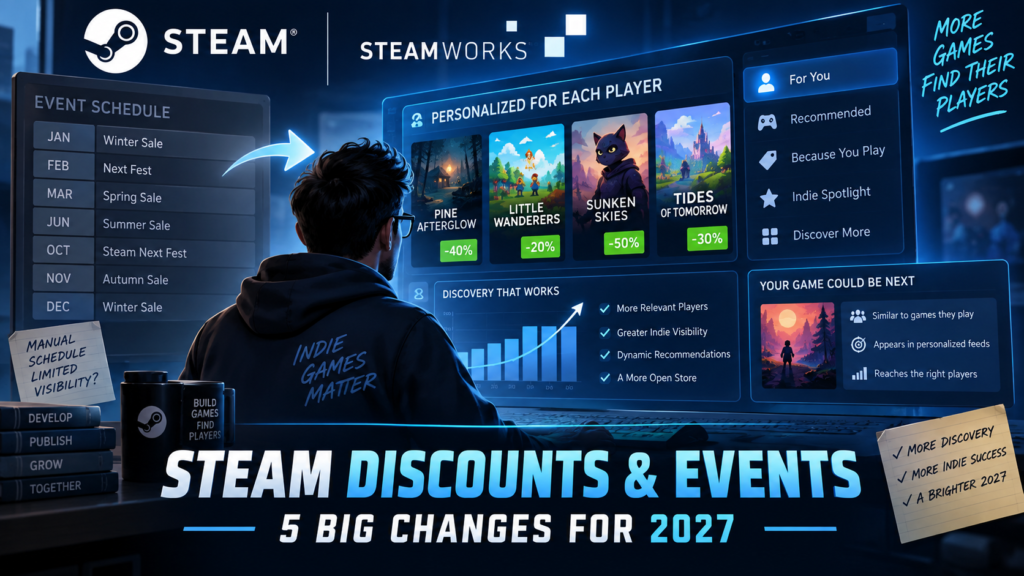
Steam Discounts and Events is getting a major discovery overhaul in early 2027, and this is bigger than Valve moving a few boxes around the homepage. The current curated calendar that controls prominent deal placements is being phased out in favor of more personalized recommendations for each customer. For indie developers, that changes the question from “How do I get one scarce promo slot?” to “How do I make Steam understand exactly who should see my game?” Read Valve’s official Steam Discounts and Events announcement.
What changes at a glance
- Curated calendar: Valve plans to stop relying on the fixed Discounts and Events calendar in early 2027.
- Discovery: Personalized recommendations will play a much larger role in what discounted games each customer sees.
- Exposure: Valve says its tests showed customers more than 10 times as many games per day.
- Curated deals: New Weekend Deal, Midweek Deal and Daily Deal placements are no longer being scheduled.
- Seasonal sales: Steam-wide seasonal sales and themed events are still part of Valve’s marketing system.

1. Steam Discounts and Events is moving away from the fixed calendar
Valve says the current Steam Discounts and Events section is built from curated placements scheduled either by partners through Steamworks or directly by the Steam team. That system creates obvious scarcity. A developer can have a great discount, but there are only so many manually scheduled placements available. Valve expects to stop using that curated calendar for this section sometime in early 2027, although the company has not announced the final rollout date yet. Read Valve’s plan for the new Steam Discounts and Events model.
For smaller studios, the practical change is huge. The old mental model encouraged developers to treat a coveted promotional slot like a major event. The new model asks them to think more like the recommendation system does: what genre is this, who actually clicks it, which tags describe it accurately, how strong is the store capsule, and what kind of customer has already shown interest in similar games? That is less predictable, but it potentially gives more games a shot at being surfaced. See Valve’s official explanation of the change.
2. Valve says customers saw more than 10 times as many games per day
The most important number in Valve’s announcement is not a discount percentage. During testing, the company says the personalized version of Steam Discounts and Events showed customers more than 10 times as many games in a day compared with the older curated layout. Valve also reports meaningful increases in store-page visits, wishlists and cart additions during those experiments. Read Valve’s reported test results.
That does not mean every indie game suddenly gets 10 times the traffic. Valve did not publish raw conversion numbers or promise equal exposure. The useful takeaway is narrower: the redesigned system can rotate through a much larger pool of relevant games instead of spending most of its real estate on a small manually chosen set. That creates more opportunity, but it also means developers will need to compete harder on relevance and store-page conversion. See the Steamworks announcement for the limits of the published data.
3. Weekend Deals, Midweek Deals and Daily Deals are already changing
Valve has paused scheduling new curated placements for Weekend Deals, Midweek Deals and Daily Deals inside Steam Discounts and Events. Existing scheduled commitments will still be honored, but developers should stop building a 2027 marketing plan around the assumption that one manually booked homepage promotion will carry a sale. Check Valve’s current Steam discount documentation.
Discounting itself is not going away. Developers can still configure promotions through Steamworks, and Valve’s documentation says discounts of 20% or greater can trigger wishlist email notifications for eligible users. The important change is distribution, not the existence of discounts. A sale still needs a good price and a good product page, but the system deciding who sees that sale is becoming more personalized. Review Steam’s official discount rules and tools.
4. Seasonal sales and themed Steam events are not disappearing
One easy mistake is to read this announcement as “Steam is killing sales.” It is not. Valve’s official event calendar still lists major seasonal sales and themed events. The Steam Autumn Sale 2026 is scheduled for October 1 through October 8, beginning at 10:00 AM Pacific, and the Winter Sale is scheduled for December 17 through January 4. See Valve’s official upcoming Steam events calendar.

Themed Fests also remain part of Steam’s discovery ecosystem. Valve says these events can feature discounted games, demos, free-to-play titles and upcoming releases, with placement shaped by eligibility, tags, player interest and other heuristics. So the takeaway for developers is not “stop planning events.” It is “stop assuming one type of hand-curated deal slot is the center of the whole plan.” Read Valve’s themed sale event documentation.
5. Indie visibility may improve, but the algorithm becomes the gatekeeper
For small teams, the upside of Steam Discounts and Events is obvious: more games can be surfaced instead of competing for a tiny fixed calendar. The tradeoff is that visibility becomes more dependent on recommendation logic and player behavior. That does not automatically hurt indies. It means the basics may matter even more: accurate tags, readable capsule art, strong wishlists, sensible pricing and a store page that communicates the fantasy in seconds. Read Valve’s explanation of the personalized model.
That is also why discovery coverage matters. Our Steam indie games worth watching roundup is a good example of the human side of the same problem: if a game’s hook is not immediately clear, neither an editor nor an algorithm has much to work with. Better discovery does not rescue a confusing pitch. It gives a clear one more chances to reach the right audience. See our recent Steam indie discovery roundup.
What developers should do before 2027
- Make the capsule art legible at thumbnail size. If a player cannot understand the game while scrolling, personalized placement will not magically fix it.
- Audit your tags. Steam uses tags and behavior to connect games with likely customers, so inaccurate tags can work against discovery.
- Build wishlists before the discount. A sale works better when an audience already exists to react to it.
- Use seasonal and themed events strategically. These are still major discovery surfaces and are not being removed by this change.
- Track conversion, not just impressions. More visibility only matters if the store page turns that visibility into wishlists, carts and purchases.
This is not dynamic pricing
Some community discussion around Steam Discounts and Events immediately jumped to dynamic pricing. That is not what Valve announced. The change is about personalized placement of discounted games and events, not automatically charging different customers different prices for the same game. Personalized discovery and personalized pricing are two completely different systems. Read Valve’s original announcement for the exact scope.
Why this matters for indie developers
The real shift is philosophical. Valve is replacing a scarce editorial calendar with a system designed to show more relevant promotions to more people. If the live version behaves like the experiment, smaller games may get more chances to appear in front of players who actually care about them. If the recommendation system becomes too opaque, developers may have a harder time understanding why one sale travels while another disappears. Either way, a strong Steam page becomes even more important. Follow the official Steam Discounts and Events update.
Sources and Official Links
Steamworks Development: Upcoming Changes to the Discounts & Events Section on Steam
Steamworks discount documentation
Upcoming Steam events
Steam themed sale events


Pingback: GOG Game Deals: 5 Best Discounts, $40 RPG for $1.99