
Rocket League is one of the worst possible games to rebuild if your plan is to shrug and say, “close enough.”
A player can spend thousands of hours learning the exact timing of an aerial, the way a car catches a wall, the feel of a flip reset or the split-second response between controller input and contact. Change something tiny and a professional player will notice before most of us have finished asking whether the lighting looks nicer.
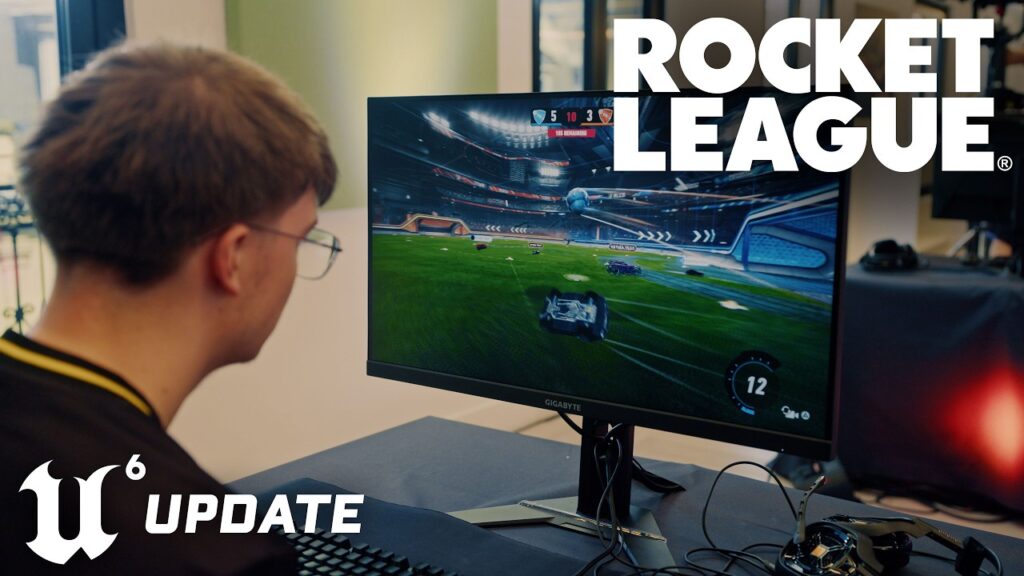
That is why the newest look at Rocket League’s Unreal Engine 6 transition is more interesting than a normal engine-upgrade trailer. Psyonix has been putting the rebuild in front of professional RLCS players and content creators, gathering feedback while the new version is still being retooled.
The migration is no longer just a tech-demo promise
Rocket League’s official site currently promotes the UE6 project with a simple line: “New Era. New Engine. This is Rocket League.” The project is a huge technical leap for a game that originally shipped on Unreal Engine 3.
At the 2026 RLCS World Championship, Psyonix showed footage from playtest sessions involving professional players. Esports reporting from Sheep Esports says players and creators have been involved at multiple LAN events and that the UE6 version is targeted for 2027.
The important signal is not that pros got an early build. It is what Psyonix is testing with them: whether Rocket League still feels like Rocket League when the technology underneath it changes by three engine generations.
For players, physics fidelity beats graphics
There is an obvious visual upside to moving to a modern engine. Better rendering, improved tools and a cleaner foundation are easy marketing wins. But Rocket League is effectively a competitive instrument. Its value comes from consistency.
If a UE6 rebuild changes ball behavior, collision timing, car response, latency characteristics or even the visual readability of a touch, veteran players can feel it. Psyonix bringing high-level competitors into the loop early is therefore exactly the sort of QA this migration needs.
Reports from the playtest video are encouraging precisely because the feedback was not universally polite. Players discussed mechanics that felt off or laggy and said developers were listening closely. That is healthier than a showcase where everyone is contractually amazed.
For game developers, this is the useful lesson
Epic’s UE6 roadmap explains why this project matters beyond one car-soccer game. Unreal Engine 6 is intended to unify UE5 and UEFN, introduce a Verse-based gameplay framework, improve iteration, support portable content and expose more engine capabilities through MCP and model-assisted workflows.
Epic is targeting UE6 Early Access for the end of 2027, with a full release 12 to 18 months later. Rocket League is therefore functioning as more than a customer. It is a brutally sensitive proving ground.
That creates a lesson for smaller teams too: when replacing a foundational system, test with the users who are most capable of detecting behavioral drift. A prettier replacement that subtly ruins muscle memory is not an upgrade.
What should current Rocket League players do?
Nothing dramatic. The current game is still the game. Season 24 arrives September 23, and Psyonix has not told players to abandon their existing progression, inventory or competitive plans.
The UE6 rebuild is something to watch, not something to prepare a funeral for. Until Psyonix publishes migration details, do not assume anything about account progression, item portability, system requirements or platform changes.
The big questions still unanswered
We still need concrete answers on whether the rebuild will replace the existing client outright, how inventories and player history move across, whether all current platforms make the transition, and what performance targets Psyonix is aiming for.
We also need to see how close the competitive physics model is to the version players have spent a decade mastering. That is the real review criterion.
ZerotoBeast Take
The best thing Psyonix could show right now is not ray tracing. It is an RLCS pro saying, “this part feels wrong,” and a developer writing it down.
Rocket League’s UE6 move will succeed if the new engine gives Psyonix a better future without making veterans relearn the sport. Bringing the people with the sharpest muscle memory into the process early is a very good sign.
Follow Rocket League’s official UE6 updates

