
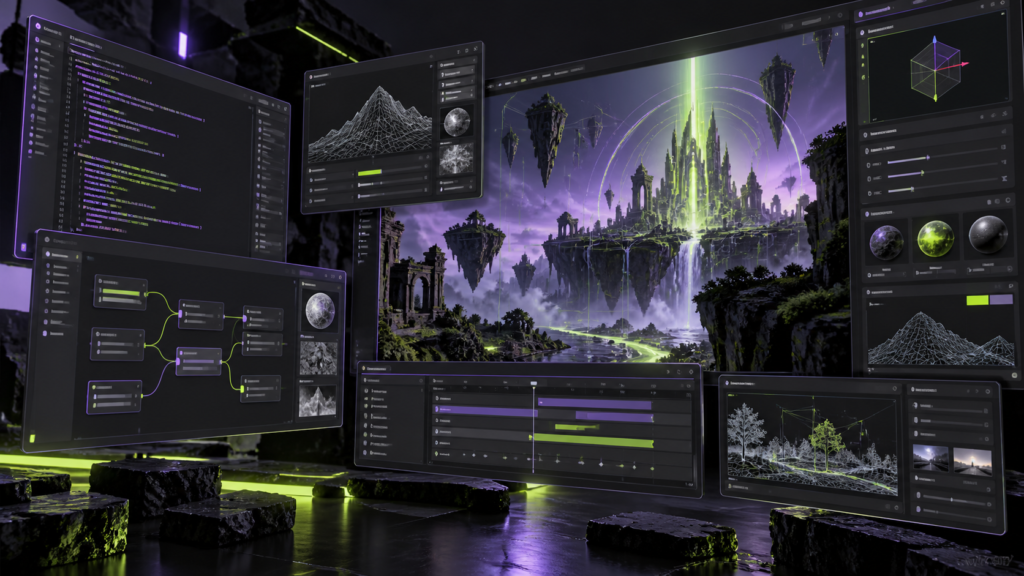
The most useful Unity 7 promise is not a prettier demo. It is fewer interruptions between changing your game and finding out whether the change worked.
Every developer knows the tiny negotiation: is this adjustment worth another compile, another trip into Play Mode, another build to the phone? Individually those waits look harmless. Repeated all afternoon, they start making design decisions for you.
That is the persuasive part of Unity 7. The announced direction combines a modernized C# runtime, more selective reloading and better access for external tools. For an indie team, the potential benefit is not “AI makes the game.” It is being able to test one more idea before the day ends.
Unity targets a December 2026 preview and a full release in Q1 2027. Those are plans, not a production commitment. This article is a documentation-based assessment, not a benchmark or an upgrade test.
First, separate Unity 7 from things you can use now
The keynote bundles several timelines into one exciting story. Your project needs a less exciting, more useful distinction.
| Part of the story | What to do with it |
|---|---|
| Unity 7 and its CoreCLR direction | Plan and investigate compatibility. Do not make an imminent delivery depend on the target release. |
| Unity CLI and experimental Pipeline tooling | Evaluate a bounded automation task in a copy of an existing Unity 6 project; these are not all waiting for Unity 7. |
| Project Auditor and reload preparation | Find the compatible analysis tools for your current Editor, then build a real list of issues to investigate. |
The current Unity 7 product FAQ describes it as a continuation of the 6.x line. Importantly, it does not promise zero breaking changes: it names obsolete APIs, package changes, advancing platform minimums and removed deprecated features as possible upgrade work. “No major rewrite expected” is a much safer interpretation than “press Upgrade without a backup.”
There is a documentation wrinkle too. Unity’s earlier CoreCLR upgrade guide still uses the Unity 6.8 name, while its later public announcement presents the next generation as Unity 7. Follow the release notes and migration guidance for the exact version you evaluate; do not substitute a marketing version number into an older technical instruction and assume everything still matches.
What faster iteration would actually buy you
The keynote describes moving toward CoreCLR, .NET 10 and C# 14, with selective code reload instead of repeatedly rebuilding the entire managed-code environment. The attraction is straightforward: change a small thing, then test that small thing sooner.
Consider a designer and programmer tuning a jump. They need to inspect the result, adjust it, and repeat until it feels right. The productive loop is not writing the first formula. It is comparing versions against intent. Reducing the interruption between trials could make the team more willing to experiment instead of settling for “close enough.” That is our workflow analysis, not a measured Unity 7 result.
Do not confuse that with a guaranteed frame-rate improvement in the shipped game. Unity’s technical migration guide describes a performance-parity goal for the transition, with different operations potentially moving in different directions. Editor responsiveness, build speed and player performance are separate questions. A keynote timing result on someone else’s project is a reason to measure your project, not a number to put in its production schedule.
The useful homework is hiding in your static state
The CoreCLR guide’s most practical warning concerns assumptions about reloads. Static data that used to be cleared during a full reload may need explicit cleanup. References that keep old assemblies alive can also obstruct the new reload model. This is the sort of problem that does not make a glamorous trailer, but can make a project’s second test behave differently from its first.
A sensible experiment is to run the same small gameplay test several times without restarting the Editor, then compare the initial state each time. Look for duplicated listeners, stale caches or setup code that only behaves correctly after a fresh launch. These are examples of questions to investigate, not a claim that every project contains these defects.
Keep a dependency inventory beside those tests: vendor, package version, precompiled libraries, native plugins, custom Editor extensions and documented compatibility. If an asset is important enough that replacing it would delay the game, its maintainer’s answer matters more than a general promise that popular packages were tested.
Project Auditor can help establish that investigation list. Its documentation describes static analysis of scripts, assets and settings. Unity 6.4 and later include the tool in the Editor, with the relevant rules package required for analysis; older installations need their compatible package/documentation path. An analysis report is a starting point, not proof that a build works or that all runtime behavior is correct.
External tools are interesting because they can close the loop
Unity’s separate CLI announcement documents an available terminal tool for Editors, modules and projects, plus structured output for automation. The experimental com.unity.pipeline package allows commands to interact with a running Editor. That distinction matters: installing a management command-line tool is not the same as granting a program live access to a project.
The practical opportunity is to make a repetitive action observable. For example: validate a changed asset against the team’s requirements, produce a clear result, then stop if it fails. An assistant that only writes a suggested fix leaves the human to discover whether it worked. A tool that can run the relevant check can provide evidence alongside the suggestion.
The same access deserves boundaries. Unity describes live C# evaluation as token-gated, and the development-player interface as localhost-only, disabled by default and not for production builds. Keep experiments in a disposable branch or project copy, with narrow tasks and reviewed changes. “It can reach the API” is a statement about power, not permission to let it change everything.
Free access to an interface also does not make every service around it free. Evaluate the actual license, provider costs and production requirements of the workflow you choose. This article does not recommend subscribing to an AI service simply because a demo uses an agent.
A sensible next week, not a speculative migration day
- Measure the annoying wait. Record a few representative edit-to-test and device-build cycles. Find the bottleneck before buying a solution to the wrong problem.
- Make a recoverable experiment. Keep the shipping branch and known-good Editor intact. Record which package and settings changes the test introduces.
- Investigate reload assumptions and dependencies. Use the compatible Auditor and migration documentation, then confirm findings with actual tests.
- Try one useful automation. A repeatable validation or test command is more valuable than a spectacular prompt with no reliable success condition.
- Revisit when the target release exists. Compare real compatibility, platform behavior and iteration results before committing the team.
For a project approaching release, waiting can be the productive choice. For a prototype or tooling branch, there is already useful preparation to do. Unity 7 is worth following because it aims at a daily development tax. The best response is to work out exactly where your project pays it.
Sources
Checked September 13, 2026. Future features and release timing remain subject to change.
- Unity’s Unite Seoul keynote recap — announcement and preview/full-release targets.
- Unity 7 product FAQ — continuity and breaking-change qualification.
- Official Path to CoreCLR upgrade guide — technical risks and older version naming.
- Unity CLI announcement — available versus experimental tooling and access boundaries.
- Project Auditor documentation — analysis scope and installation/version guidance.